M
Memory
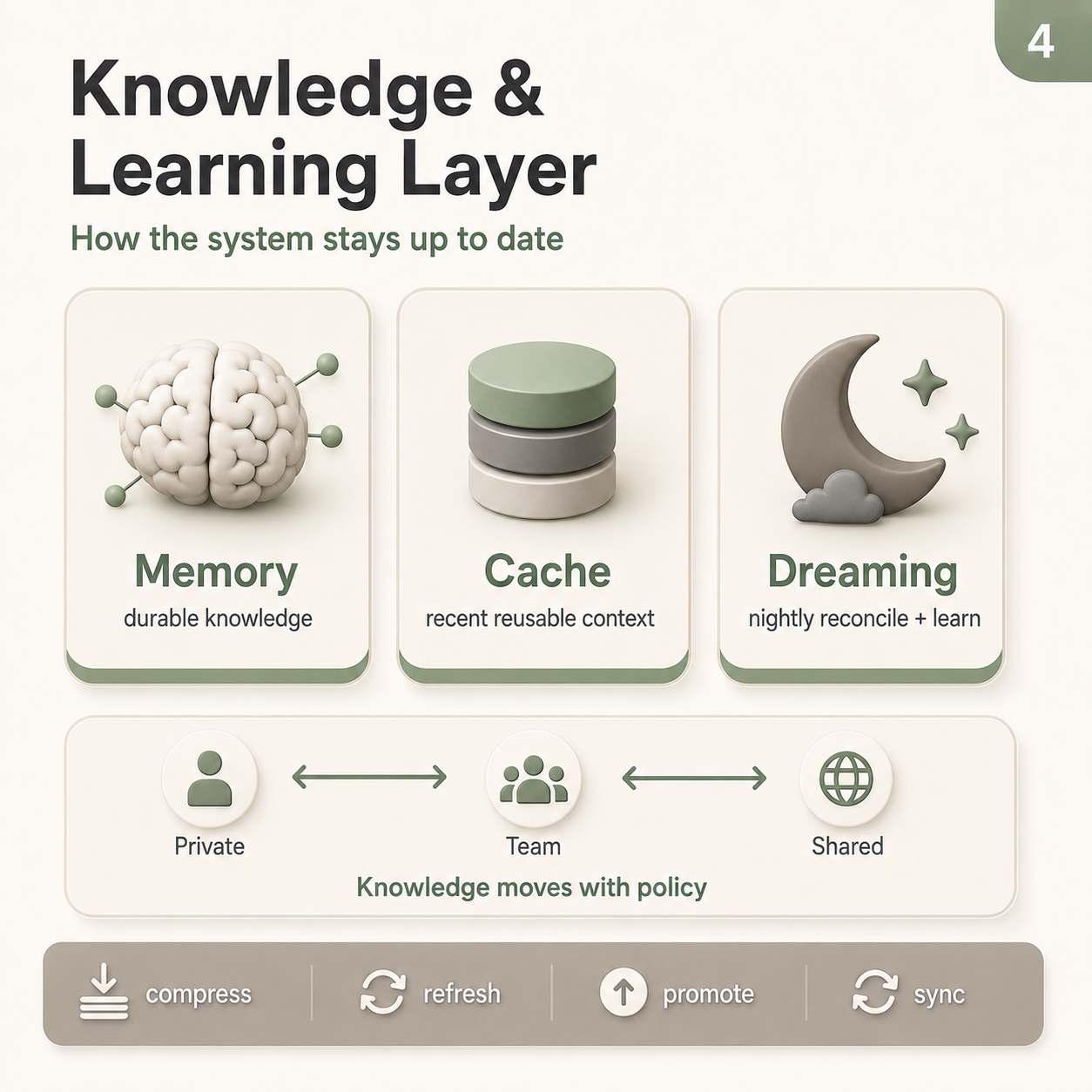
Stores durable decisions, assumptions, patterns, policies, lessons, and role-specific context across interactions.
05 / KNOWLEDGE
Learning over time
The architecture should not treat every interaction as new. Knowledge compounds when memory, cache, and governed background learning work together.
Stores durable decisions, assumptions, patterns, policies, lessons, and role-specific context across interactions.
Reuses recent prompts, context, tool results, responses, searches, and retrievals to reduce latency and cost.
A governed background process that compresses, deduplicates, resolves conflicts, expires stale knowledge, and extracts patterns.
Knowledge scopes
Private memories should not automatically become public. The knowledge router generalizes useful insights and verifies permissions before promotion.
Freshness is part of truth
Different facts age at different speeds. Agents need source, creation time, and TTL metadata to judge whether cached knowledge is still trustworthy.
Real time + over time
The communication router asks, “What matters now?” Dreaming asks, “What did we learn across time?” Together they make the system responsive and cumulative.
More than memory
Dreaming can update memories, skills, policies, routing rules, caches, and knowledge bases. The goal is not to remember every message. It is to make future execution better.
See learning in a scenario →