Shared conversations, decisions, approvals, exceptions, and escalations.
02 / ARCHITECTURE
The complete system
Six blocks.
Three planes.
One loop.
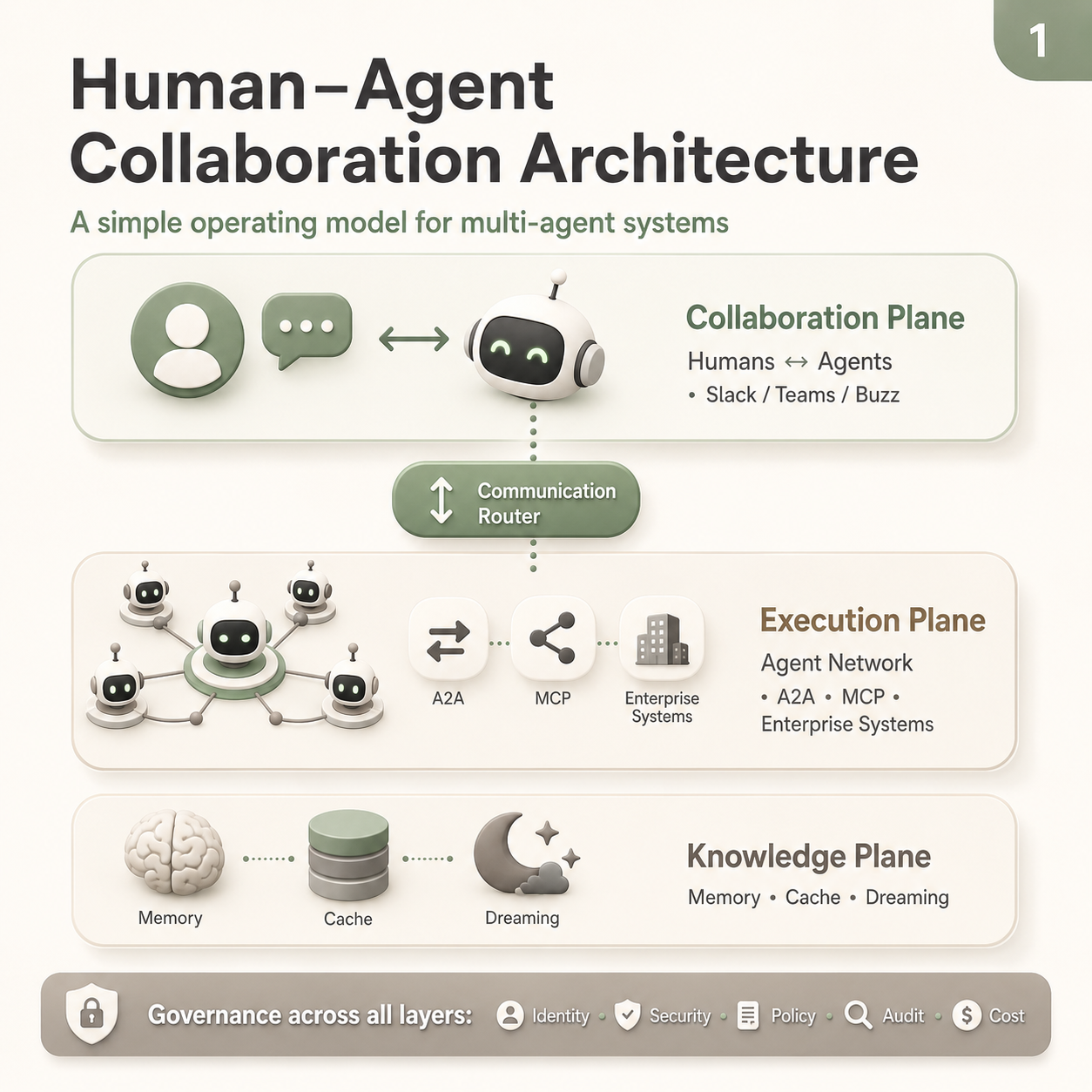
A separation of concerns for enterprise agents: execute privately, collaborate visibly, learn continuously, and govern every boundary.
- 01 Collaboration
- 02 Router
- 03 Agent network
- 04 Systems & tools
- 05 Governance
- 06 Knowledge
System map
The architecture
at a glance.
The communication router is the bridge. Governance is the rail. Knowledge touches both the visible workroom and the private machinery beneath it.
Specialist agents delegate and synthesize structured work at machine scale.
Private, team, and organizational knowledge remains fresh and reusable.
↕
Classifies significance, compresses context, enforces policy, and selects the right audience.
Agents access ERP, CRM, databases, search, code, email, and workflows through MCP, APIs, and connectors.
Moves knowledge between private, team, and organization scopes through explicit policy.
Governance across every plane
IdentityPermissionsSecurityPolicyAuditObservabilityCost
Different planes, different jobs
Get work done. Decide what to do. Remember what was learned.
Execution optimizes for speed and structured delegation. Collaboration optimizes for shared understanding and authority. Knowledge optimizes for reuse and improvement over time.
The agent as a unit
Every agent owns a bounded operating context.
Agents are not just models. Each has a role, skills, tools, data, memory, permissions, policy, and communication interfaces.
Agent → tools
Grounded access to authorized data, APIs, and actions.
Agent → agent
Discovery, delegation, status, artifacts, and task results between autonomous specialists.
Agent → people + agents
Findings and decisions exposed in a persistent shared workspace.
Next concept